
Never On Sunday (1960)
A Myth-Tinted Holiday in Midcentury Piraeus

Today on A Reception Collection, I’m sharing a Greek cinema classic. It’s light-hearted, it’s scintillating, and it features some pretty fascinating engagement with the country’s ancient past.
I’ve been working extensively with modern Greece for my paid job over the past couple years, and the modern Mediterranean loomed large over my thesis research. I’ve also written a few assignments about modern Greece for my current studies, including a research guide to finding the Greek diaspora in BC archives and a paper on using archives to track public opinion of the Parthenon Marbles repatriation. Since recent Greek history has been on my mind lately, I wanted to share a particularly fun example of ancient reception from this time period.

Never on Sunday is a 1960 romantic comedy movie, set and filmed on location in Piraeus. This is the historic port town that connected the Athenian city-state to the Aegean Sea in antiquity; in modern times, it’s become a suburb of Athens. Like many port towns, Piraeus historically has a reputation for being a bit rough around the edges. Never on Sunday offers us glimpses of the port’s working-class inhabitants doing their best to get by, while also finding little ways to enjoy life. The main plot involves Ilya, a sex worker played by Greek actress and activist Melina Mercouri, and her whirlwind, will-they-won’t-they relationship with the fantastically named Homer Thrace, a visiting American intellectual. The French actor and filmmaker Jules Dassin played Homer and directed the movie; he and Mercouri were a married couple in real life, so their onscreen chemistry is something to behold.
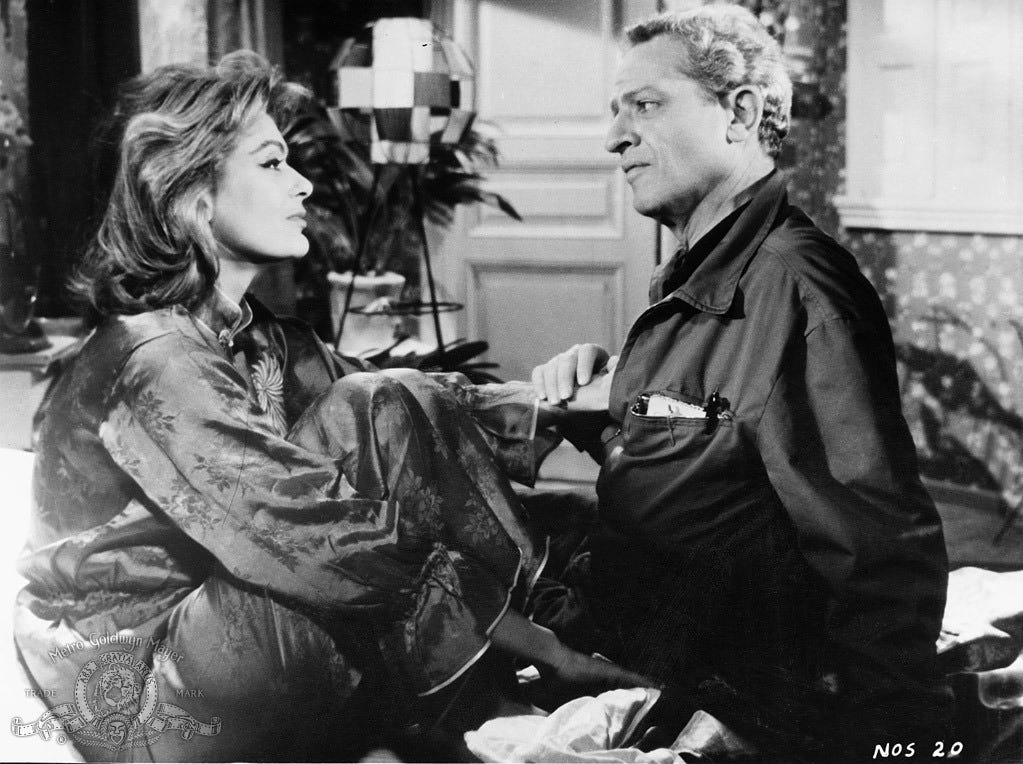
Never on Sunday isn’t set in the ancient world, but it deals heavily with the legacy of ancient Greece and what it’s like to live in a country where antiquity looms large. While going about their lives in contemporary Piraeus, the characters directly engage with visuals and stories from classical Athens. At first, Ilya and her friends and neighbors don’t demonstrate many connections to the ancient world; they’re too busy with their day-to-day activities. Homer’s arrival in Piraeus disrupts this rhythm. He’s a tourist steeped in contemporary academic perceptions of antiquity, believing that Greece has declined and fallen since its heyday in the BCEs. These attributes could have easily been assigned to a snobby, unlikable character; however, Homer comes across as more bumbling and clueless than stuck-up. The movie spends a lot of time painting him as the odd man out in Piraeus. The locals always have a comeback to his cloudy-eyed musings about the forgotten dream of antiquity. He’s a kooky foreigner, as opposed to a relatable point of view character experiencing strange locals, as is all too often the case in movies set in popular tourist destinations like Greece.

The people of Piraeus in Never on Sunday also have a vibrant local culture, running counter to Homer’s ideas of modern Greece as a shadow of its former self. The movie is bursting with music and scenes of workers’ leisure time, from rowdy nights in the local taverna to an opening sequence where Ilya leads a group of shipbuilders and sailors in an afternoon dip in the sea. Homer is thrust into a town that’s full of life and color in the present moment, regardless of what happened in ancient times. With all this in mind, Homer reads as a gentle satire of nerdy classicists, as well as of western expats who visit Greece expecting a paradise of white marble ruins.
Homer’s initially confused and disappointed by his time in Piraeus and how it sharply differs from his ideas about Greek history. Ilya serves as a foil to these negative emotions; Homer’s instantly struck by her charisma and her beauty, as well as her free-spirited lifestyle. She does business with the men of Piraeus of her own free will and thoroughly enjoys her job. Through her character, Never on Sunday does romanticize sex work and play into some dated ‘happy hooker’ tropes. There’s a few brief allusions to unpleasant aspects of sex work, including a subplot where the other sex workers in Piraeus fight against an exploitative pimp. Most of the focus is, however, on Ilya and how she loves her lifestyle. I’m not saying that her story needs some darkness, merely pointing out that she taps into played-out ideas about sex work and sex workers. Despite the imperfections of her portrayal, I find it refreshing to see a narrative where a woman values her independence and individual happiness above all else, especially in a movie from the early 60s!

Soon after meeting Ilya, Homer starts perceiving her as a personification of his ideas about antiquity and the decline of Greece. He believes that, by educating her and leading her away from her pleasure-centric lifestyle, he will, in a way, be elevating Greece back to its former glory. He’ll be coincidentally molding Ilya into his ideal woman; she’s already beautiful and spirited, but he wants her to also be educated and refined and capable of intellectual conversations. If you’re anything resembling a film or theater buff, you’ll recognize this plot as a variation on the midcentury musical and movie My Fair Lady, or Pygmalion, the 1912 George Bernard Shaw play that inspired My Fair Lady. The latter of these pieces of media takes its name from a sculptor in Greek mythology, who fell in love with one of his own statues and prayed that she would come to life. Post-ancient sources call the woman in the Pygmalion story Galatea, but in Ovid’s Metamorphoses she doesn’t even get a name. Since the Metamorphoses is our most extensive source for this myth, her lack of any human characteristics beyond a pulse is downright chilling.
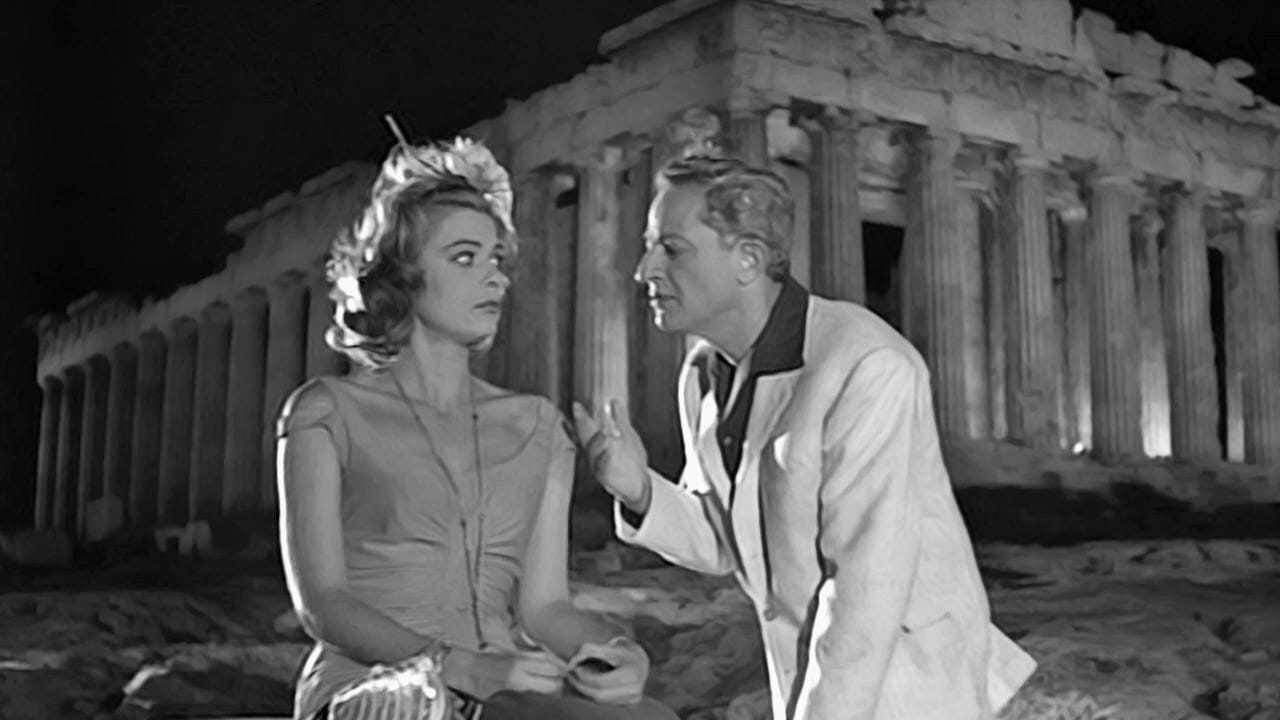
Thankfully, Ilya is far from a blank slate in Never on Sunday. She has plenty of her own opinions about antiquity; when Homer starts trying to teach her about her own heritage and culture, she’s quick to retort and throw a wrench in his lecturing. One particularly striking argument of theirs takes place during a visit to the Acropolis, the dialogue unfolding with ancient temples in the background. Ilya knows her ancient tragedies particularly well, although she has a habit of re-working them, imagining them with different plots. The movie frames her story reworkings as naive and overly optimistic: however, is she actually ahead of her time? Ilya is especially fond of giving happy endings to women from Greek mythology. I wonder what she’d think of the feminist myth retellings that have swept the popular literature landscape over the last decade or so. I also wonder if Ilya sees herself in these women. Homer is fond of likening her to ancient figures: perhaps her myth re-workings are a way to claim these women and absorb them into her own life. By giving them happy endings, is she imagining a happy ending for herself? Or is she, perhaps, bringing these women into her own world, offering them the life she proudly leads?
Ilya pays special attention to one specific character from mythology; I get the impression she’s her favorite. Never on Sunday may be a variation on the Pygmalion theme, but it engages just as plentifully with the figure of Medea. The characters have several conversations about her, including a delightful scene where Ilya tells a shocked Homer her liberally altered version of Medea’s story. No one on screen directly compares Ilya to Medea, but we viewers are invited to place the two women in conversation. I read Medea’s presence in the film as a cautionary one. Carefree, joyous Ilya is a far cry from the formidable, vengeful mythic sorceress, but there’s potential for the two women to become a symbolic pair. If Ilya marries Homer, becomes his ideal intellectual woman- the Galatea to his Pygmalion- and leaves her life in Piraeus behind, she might turn into a Medea-like figure over time. The theme of displacement is a major one for Medea. She comes from Colchis, on the shores of the Black Sea, moves to Greece with her hero lover Jason, and becomes a foreigner in a strange land. Euripides’ tragedy play version of her story places constant emphasis on how she’s an isolated figure in Greece, severed from any type of support or community. The other characters in his play, who are all Greeks, think of her as frightening in her otherness.
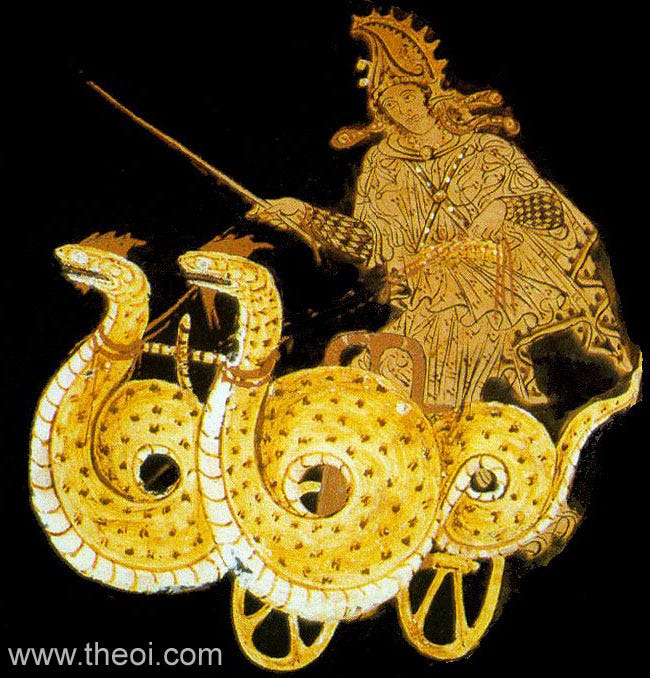
Ilya spends the duration of Never on Sunday right at home, surrounded by people who care about her and understand her. However, her encounters with Homer are tinged with a subliminal threat of displacement. Even though Homer loves life in Greece and makes some valiant attempts to blend in with the locals (there’s a pivotal scene where he gets drunk on ouzo and dances in a taverna), it’s out of the question that he would stay in Piraeus and integrate into Ilya’s life if they became a couple. Likewise, Jason staying in Colchis is never something anyone considers in mythology. The affections of both men come with a hefty price: total cultural alienation and displacement.
Luckily for Ilya, she can to have a go at living out Homer’s fantasies without leaving Piraeus. At his request, she tries to give up her hard-partying ways, dedicating herself to studying and pouring over philosophy books. It makes her absolutely miserable. After only a brief period of living this way, she decides Homer isn’t worth giving up her entire lifestyle and personality. The scene where she decides to go back to living on her own terms is arguably the centerpiece of Never on Sunday. It’s also a musical number, with Ilya making her decision in song. This is a film full of music, but this is the one time the plot stops so we can hear a character sing. Ilya takes a moment alone to swan around her bedroom, singing a song that extols the praises of Piraeus. Its lyrics remind her how she loves life in her seaport home and how she takes pride in her work (much of the second verse is about the joys of having multiple lovers and enjoying the company of whoever she likes!). This song, Ta Paidia Tou Pirea (that’s Greek for The Children of Piraeus), has been a beloved classic in Greece for decades; it was also a massive international hit in the early 60s, with dozens of cover versions in different languages.
This Paidia Tou Pirea scene shatters the Pygmalion premise over the course of only a few minutes. To my delight, the movie treats this as a net positive, making fun of Homer for failing to appreciate Ilya’s way of life. Never on Sunday is a rare rom-com where the main couple go their separate ways at the end, with a solitary Homer boarding a boat back to the States. The ending is bittersweet: you get the sense that Homer and Ilya had feelings for each other, but realized they aren’t compatible. A wonderful Hellenic studies professor of mine once quipped that Never on Sunday is the quintessential modern Greek love story, because the main couple don’t end up together and none of the working-class characters escape poverty! Nevertheless, the movie ends with a big joyous party sequence and everyone dances. It’s as if one of Ilya’s altered versions of Greek myths has just unfolded in real life. Unlike Galatea, she gets to be her own person and make her own way through life, unburdened by what men want her to be. Unlike Medea, she stays among her kindred people and has no reason to mount a bloody spree of revenge. Ilya gets a well-deserves happy ending, regardless of whether it aligns with mythological standards.
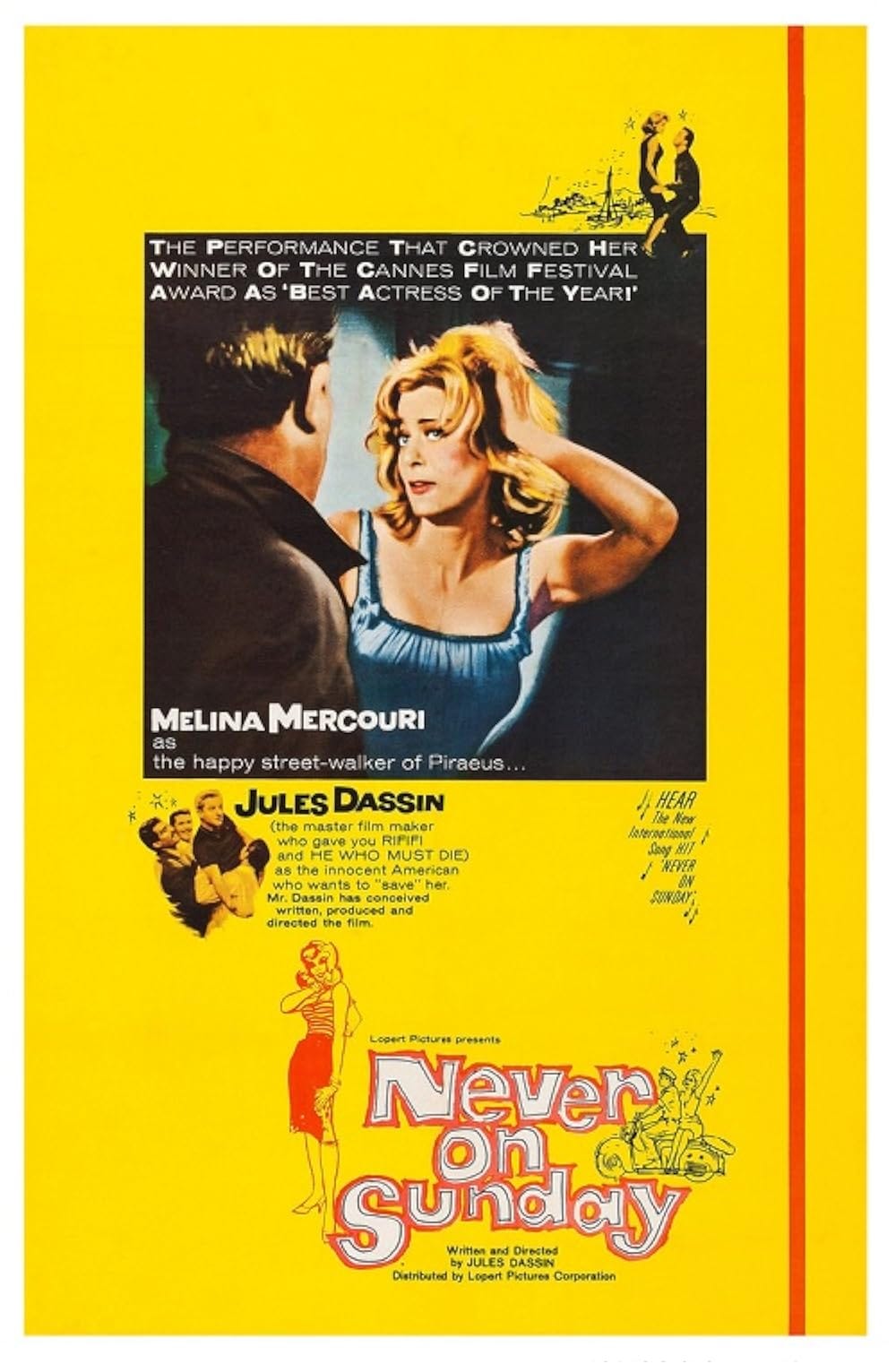
If you’d like to watch Never on Sunday for yourself, and I highly recommend that you do, the full movie is available on streaming and versions of it occasionally pop up on YouTube and Dailymotion. Make sure you find a version with subtitles. Since the movie’s dialogue is in a mixture of Greek and English, these subtitles do a lot of heavy lifting…
I would be a fool to finish up this post with anything except the Muppets parody of Never on Sunday. Miss Piggy, play us out!
Now I definitely have to go rewatch this one!